The 24-hour pause: a quiet feature for the loudest moments
The most useful thing a co-parenting app can sometimes do is stop the messages.
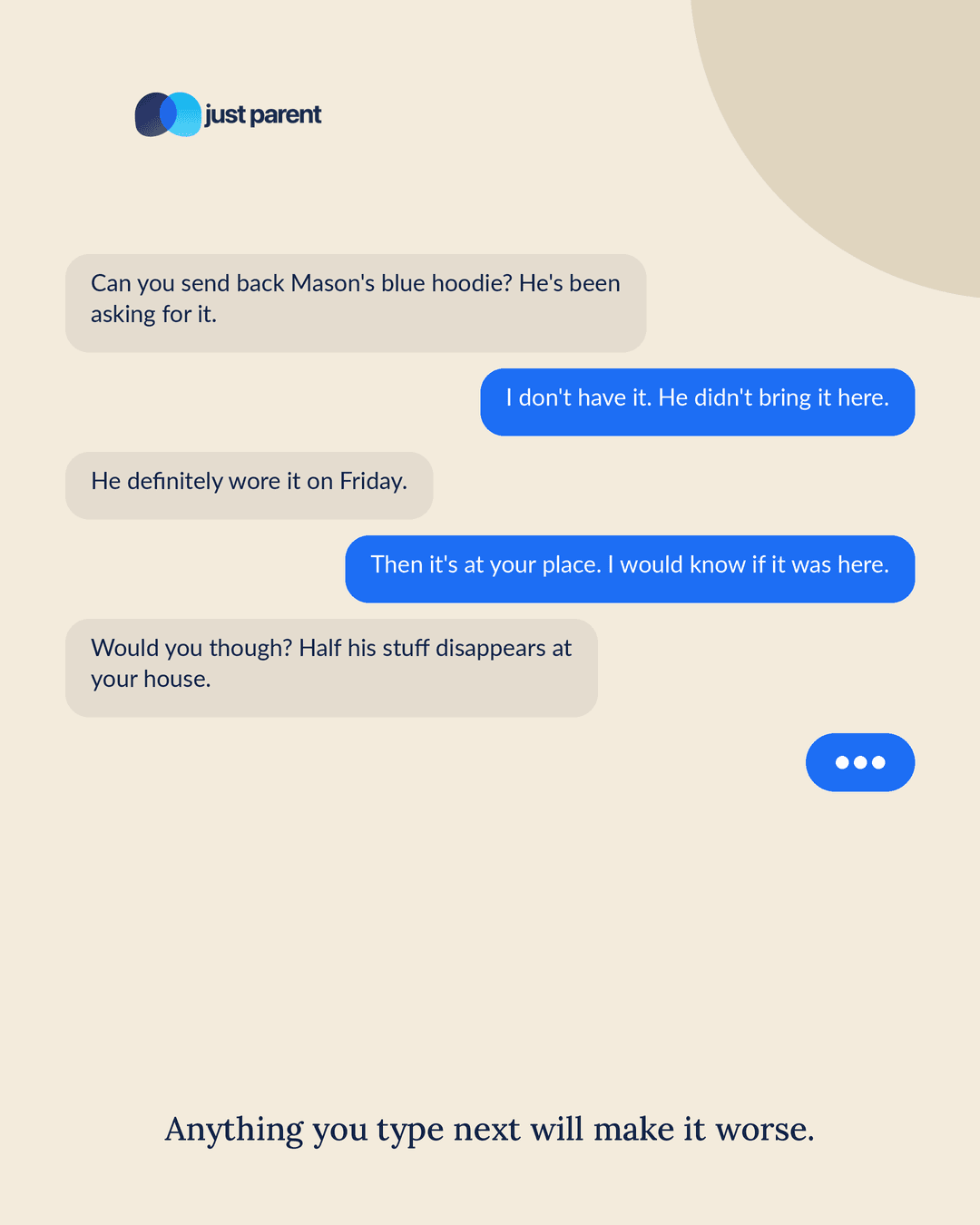
Every co-parent has had a version of the same moment. It's late. A message thread has gotten away from you. The other parent has said something cutting. Your phone is in your hand and you can feel the reply forming. You know, even as you type it, that anything you send next will make tomorrow worse.
For a long time, the only advice for that moment was "don't." Put the phone down. Sleep on it. Reply in the morning. It's good advice, and it almost never works in the moment, because the urge to defend yourself is louder than the discipline to wait.
There's a better answer, and it's a structural one. Build the wait into the channel itself.
Why "just don't reply" fails
The problem with willpower advice is that it ignores the physiology. By the time a co-parenting thread has gotten heated, the prefrontal cortex (the part of the brain that handles measured, future-looking decisions) is offline. The amygdala is in charge. Researchers who study emotional regulation talk about the "window of tolerance": the range where you can think clearly. Outside that window, you're not making decisions, you're reacting.
What works in that state is not more discipline. It's removing the option to react. Most addiction and conflict-management protocols share this principle, whether it's the 24-hour rule in disputes, a cooling-off period in retail returns, or the deliberate friction of a confirmation step on a destructive action. The structure does the work the willpower can't.
The cost of not pausing
A message sent in the wrong state compounds for days.
- Tone gets misread, sometimes deliberately. A line that felt firm at 10pm reads as aggressive at 8am.
- The reply becomes its own grievance. What started as a question about Wednesday turns into a fight about last month.
- Lawyers and judges read texts literally. Whatever you sent is the record, regardless of context.
- The kids feel the next morning. Whatever happened between the adults at 10pm shows up in the dropoff at 8am.
None of this is hypothetical. Family therapists and divorce mediators see the same pattern repeatedly: most of the bitterness that calcifies between separated parents was authored in moments that lasted less than five minutes.
What a 24-hour pause actually looks like
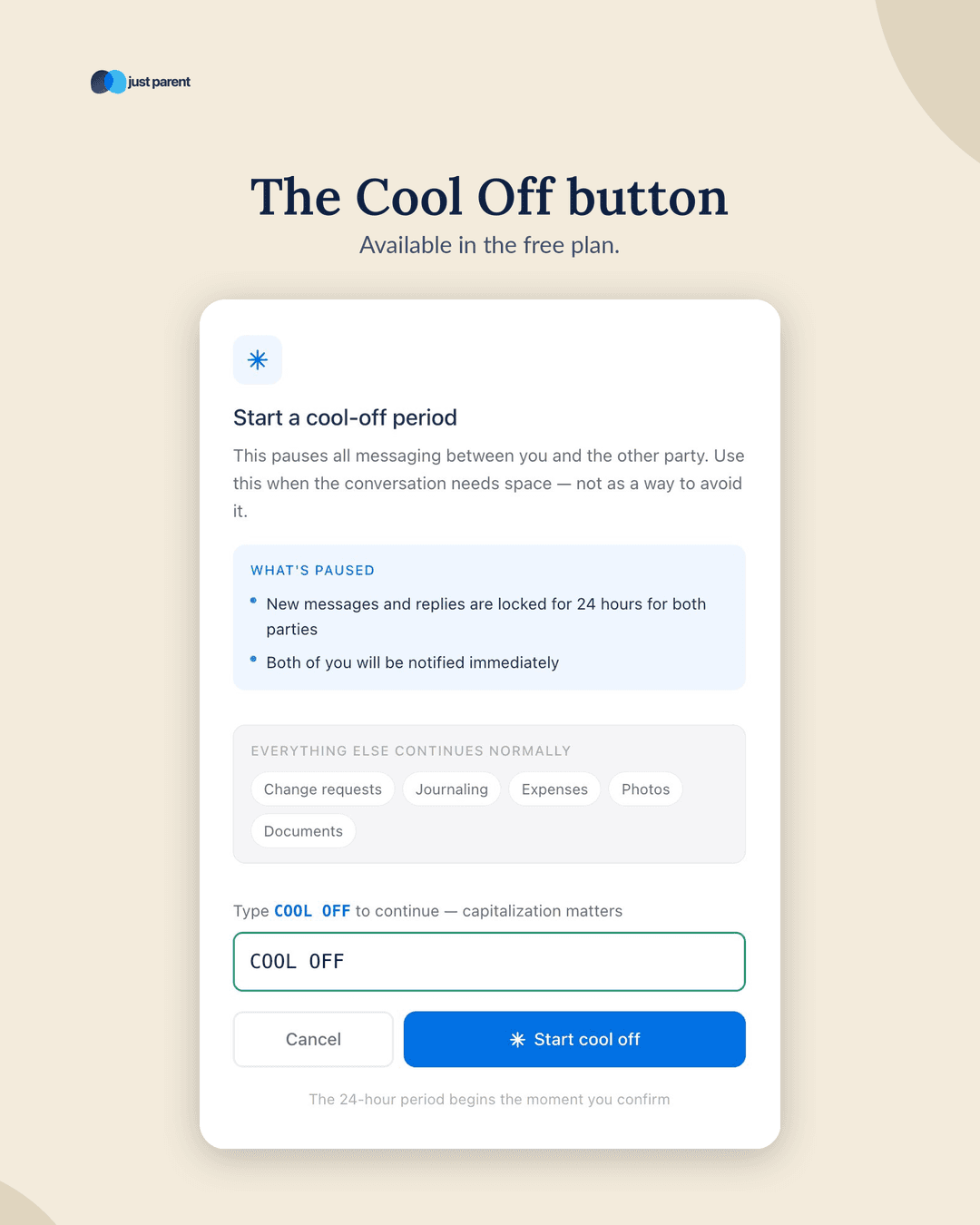
The mechanics are simple. When a conversation is heading somewhere it shouldn't, either parent can lock new messages and replies for 24 hours. Both parties are notified immediately. There's no mystery and no silent treatment, just a clear, mutual pause.
The deliberate piece is the friction at the start. Activating the pause requires a confirmation step, often by typing the words "cool off" or similar. That tiny moment is the whole point. It's slow enough to require a real decision, fast enough that it doesn't get in the way when it's needed.
The 24 hours is also a deliberate choice. Long enough that the body returns to baseline. Short enough that no one feels stonewalled, and short enough that essential coordination can resume the next day.
What stays open during the pause
A good pause closes the channel that's hot, not the channels that matter.
- Custody change requests still work. Need to swap a pickup? That's not a fight, that's logistics.
- Journaling stays available. The 24 hours doesn't erase what happened that day with the kids.
- Photos and documents continue to flow. A receipt for shared expenses, a school form, a permission slip.
- Emergencies have their own channel. Nothing about a pause should interfere with safety.
This distinction matters. A pause that locks everything is a punishment. A pause that locks only the messaging is a tool. Co-parents who use the feature regularly describe it the same way: it's not about avoiding the conversation. It's about having the conversation later, in a state where it can actually go somewhere.
Who this is for
It's tempting to imagine the 24-hour pause as a tool only for high-conflict cases, the kind where parallel parenting is the recommended model and every interaction has legal weight. Those families absolutely benefit. But the feature is just as useful for the calmer end of the spectrum.
The unexpected trigger doesn't follow a conflict bracket. A surprise change to the school schedule, a fight about a missing hoodie, a misread tone in a text sent during the workday. Even families that consider themselves low-conflict have moments that get away from them. A structural pause is for those moments too.
What the pause is really doing
It would be a stretch to call a 24-hour pause therapy. It's not solving the underlying patterns that make a thread heat up in the first place. Those are slower problems that benefit from coaches, therapists, and time.
But the pause does something simpler and more immediate. It protects future-you from present-you. It treats the message you almost sent the way a thoughtful friend would: someone who knows you well enough to say "don't," with enough authority that you actually listen.
Most co-parenting tools focus on building a record of what happened. The pause is the rare feature that focuses on what didn't happen, on the message that never got sent, the fight that didn't compound, the morning that started normally because the night before ended early.
Sometimes the most useful thing an app can do is stop the conversation, and let the people involved come back to it when they can think.
The Cool-Off Button is part of just parent's structured messaging system and is available on the free plan, no subscription required.